

Bangladesh’s garment industry — the backbone of the country’s export economy — is deeply connected to global energy flows. While geopolitical conflicts in the Middle East may appear distant from Dhaka’s apparel factories, the reality is that energy geopolitics can quickly translate into higher production costs for garments.
A conflict involving Iran, especially one that disrupts the Strait of Hormuz, could trigger a chain reaction across energy markets, shipping routes, and global supply chains. The final impact may ultimately be felt in Bangladesh’s apparel FOB prices, as rising energy and logistics costs move through the production ecosystem.
Bangladesh’s Energy Dependence: A Structural Exposure
Bangladesh imports a significant share of its energy requirements, making the economy sensitive to global supply disruptions.
Around 65–70% of Bangladesh’s energy demand is met through imports, primarily LNG, crude oil and LPG from the Middle East.
Key suppliers include:
Crude Oil
- Saudi Arabia
- United Arab Emirates (UAE)
Crude oil is processed domestically at Eastern Refinery Limited in Chattogram, supplying part of the country’s fuel demand.
Refined Fuel (Diesel, Octane, Petrol)
Bangladesh imports large volumes from Asian refining hubs such as:
- Singapore
- Malaysia
- China
- Indonesia
The country also imports diesel through the Bangladesh–India Friendship Pipeline, a 131.5-km pipeline connecting India’s Numaligarh refinery with Parbatipur depot in Bangladesh.
LNG Supply
Bangladesh imports roughly 6 million tonnes of LNG annually, with around 4 million tonnes coming from Qatar through long-term contracts.
Overall, about 65% of Bangladesh’s LNG imports depend on Qatar, meaning most shipments pass through the Strait of Hormuz.
LPG Supply
Bangladesh consumes about 1.4 million tonnes of LPG annually, and nearly all of it is imported — historically from Middle Eastern producers.
The Strategic Energy Routes Supplying Bangladesh
Two major maritime routes bring fuel into Bangladesh.
Route 1: Middle East → Strait of Hormuz → Indian Ocean → Bay of Bengal
Used for:
- Crude oil imports
- LNG from Qatar
- LPG shipments
The Strait of Hormuz is one of the most critical energy chokepoints in the world, with around 20 million barrels of oil passing through daily — roughly one-fifth of global consumption.
Most LNG exports from Qatar and the UAE also transit this corridor before reaching Asian markets.
For Bangladesh, this makes Hormuz a critical energy lifeline.
Route 2: Southeast Asia → Malacca Strait → Bay of Bengal
Used mainly for refined petroleum imports from:
- Singapore
- Malaysia
- Indonesia
- China
This route bypasses the Strait of Hormuz and provides partial diversification for Bangladesh’s fuel supply.
Impact of Iran War or Strait of Hormuz Closure
Short-Term Impact (Weeks to 1–2 Months)
In the immediate phase of a conflict, Bangladesh may experience price pressure rather than physical shortages.
Possible effects include:
- Global oil prices rising sharply
- LNG spot prices increasing
- Higher LPG prices
- Freight insurance premiums rising
Bangladesh could still manage supply in the short term by relying on existing reserves and shipments already in transit.
However, global price volatility would immediately raise the country’s energy import bill, increasing pressure on foreign exchange reserves.
Medium to Long-Term Impact (2–6 Months or More)
If the conflict disrupts shipping through Hormuz for an extended period, the consequences could become more severe.
LNG Supply Risks
More than half of Bangladesh’s LNG imports transit the Strait of Hormuz, meaning disruptions could trigger gas shortages affecting power generation and industry.
Energy officials have already warned that interruptions in LNG cargo deliveries could affect power plants and industrial production.
Power and Industrial Energy Crisis
If LNG supply declines:
- Gas supply to factories could drop
- Power generation costs would rise
- Industrial production may face disruptions
Energy-intensive sectors such as textile dyeing, washing and finishing would be particularly affected.
Rising Shipping and Logistics Costs
Geopolitical tensions typically increase:
- Maritime insurance premiums
- Container shipping rates
- Bunker fuel costs
This would push up freight costs for apparel exports, affecting FOB prices.
Strategic Risk for Bangladesh
Bangladesh’s energy supply chain remains structurally vulnerable to Middle Eastern instability.
Key risk areas include:
High LNG Dependency
- More than half of LNG imports pass through the Strait of Hormuz.
Heavy Import Dependence
- Bangladesh imports the majority of its oil and LPG requirements.
Limited Storage Capacity
- LNG terminals and energy reserves provide limited buffering capacity during prolonged disruptions.
Industrial Energy Dependency
- Gas-based power generation and industrial operations rely heavily on imported LNG.
This combination creates a direct link between Middle East geopolitics and Bangladesh’s economic stability.
A short Energy Risk Exposure
| Energy Type | Risk Level |
| LNG | High |
| Crude Oil | High |
| LPG | Medium |
| Refined diesel imports | Low-Medium |
Energy Shock → Freight Inflation → Apparel FOB Pressure
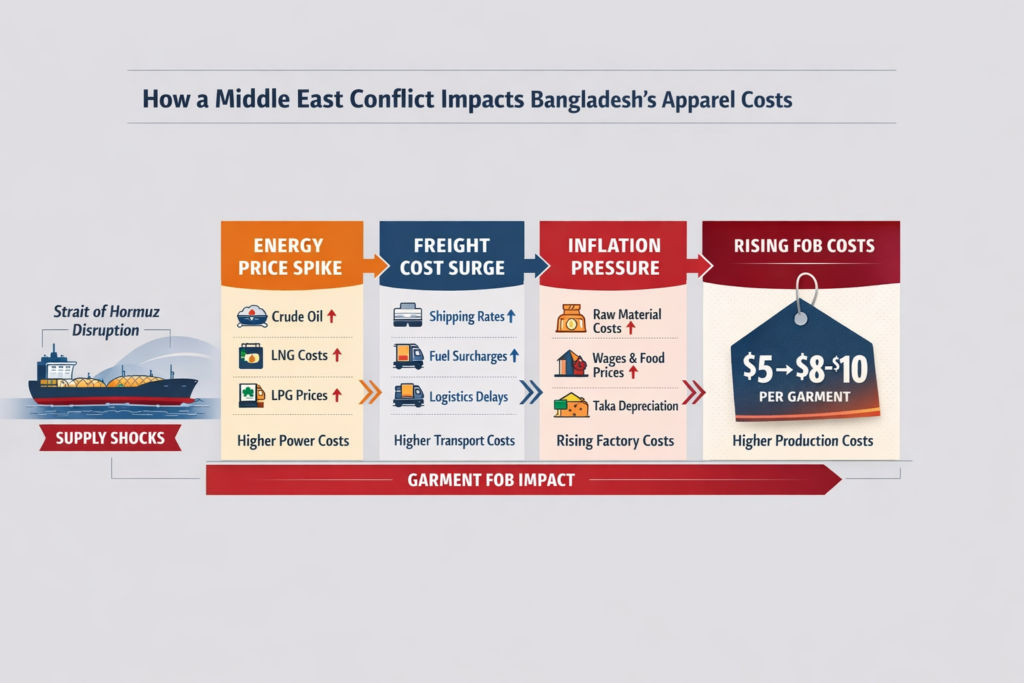
For Bangladesh’s apparel industry, energy shocks rarely remain confined to the energy sector.
They move through the supply chain in three stages:
1. Energy Cost Inflation
Higher oil and LNG prices increase:
- Electricity costs
- Captive power generation costs
- Dyeing and washing expenses
2. Logistics Cost Increase
Rising fuel prices increase:
- Inland trucking costs
- Port handling costs
- Ocean freight rates
3. Macroeconomic Pressure
Energy price shocks also drive:
- Currency depreciation
- Higher inflation
- Rising labour and operational costs
All these factors ultimately increase manufacturing costs for garments.
Strategic Implications for Bangladesh’s Apparel Industry
If energy shocks become more frequent due to geopolitical tensions, Bangladesh’s apparel industry must adapt to a new cost structure.
Key strategic responses may include:
1. Accelerating Renewable Energy in Factories
Solar rooftops and energy-efficient machinery can reduce dependence on imported fuel.
2. Diversifying Energy Supply
Bangladesh may need to expand LNG sourcing beyond the Gulf, including:
- Spot LNG markets
- Alternative suppliers such as the United States and Africa
3. Expanding Strategic Fuel Storage
Greater fuel reserves would help cushion industrial activity during supply disruptions.
4. Moving Up the Value Chain
Higher value apparel products can absorb rising cost structures better than ultra-low-price basics.
5. Improving Logistics Efficiency
Investment in port capacity, rail freight and inland logistics could reduce freight cost vulnerability.
A New Reality for Bangladesh’s Apparel Competitiveness
Bangladesh built its global apparel leadership on low production costs and efficient supply chains. But the evolving geopolitical landscape suggests that energy security will increasingly shape manufacturing competitiveness.
A Middle East conflict may seem geographically distant, but its effects could quickly travel through energy markets, shipping lanes, and logistics systems — eventually reaching the factory floor and the FOB price of a garment.
For Bangladesh, the challenge ahead is not only maintaining cost competitiveness but also building energy resilience in an increasingly uncertain global order.
(Apparel Times BD Desk)
**Data Sources: EIA, IEA, Petrobangla, BPC, BGMEA, World Bank, UNCTAD, Drewry, The Daily Star, The Business Standard.**