

Production continuity maintained as government measures stabilize fuel distribution and industry operations
Industry Overview
Bangladesh’s ready-made garment (RMG) sector continues to operate at full capacity despite fuel supply pressures observed in late March and early April 2026. The situation—driven by temporary demand spikes and global energy market volatility—has now transitioned into a managed and stabilising phase, supported by coordinated government measures and active monitoring.
Government interventions, combined with strong factory-level preparedness, have ensured continued production, stable export logistics, and prioritised energy allocation for key industries.
___
Energy Supply Situation: Key Data & Structure
As of end-March, fuel reserves were estimated at:
- Diesel: ~12–15 days
- Petrol: ~11 days
- Octane: ~8 days (with expected improvement in supply)
- LNG: Multiple cargoes secured for industrial use
Bangladesh’s fuel supply is supported by a hybrid structure:
- ~40–45% of petrol and octane demand is met through domestic condensate processing
- Installed capacity of ~7,500 barrels/day, currently operating at ~4,500 barrels/day due to gas supply constraints producing 3400 barrels Petrol & 700 barrels Octane
- Remaining ~60%+ demand is met through imports managed by Bangladesh Petroleum Corporation (BPC)
Demand Insight
- Petrol demand: ~462,000 tons
- Octane demand: ~415,000 tons
- According to FY 2023-2024 62% supported by BPC and rest 38% by own source
___
Government Measures: Supply Stabilization & Demand Optimization
Supply-Side Actions
- Emergency import (approved and in process): ~260,000 tons (100K tons crude + 160K tons diesel)
- 2 LNG cargos procurement ensured
- Diversified sourcing from global suppliers
- Keep Fuel prices same as early for April
Demand Management Measures
- From April 5th office hours reduced to 7 hours (public + private + banks)
- Industrial operations maintained at full capacity (8-hour standard)
- Market closure fixed at 7 PM (except essential services)
- Government fuel consumption reduced by ~30%
- Online education introduced to reduce transport demand
___
BGMEA Initiatives: Industry Preparedness
- Collection of factory-level generator capacity data
- Assessment of daily diesel requirement (based on 4-hour load-shedding scenario)
- Industry-wide contingency planning
Indicates proactive risk management, not reactive response.
___
RMG Sector Status: Production & Logistics
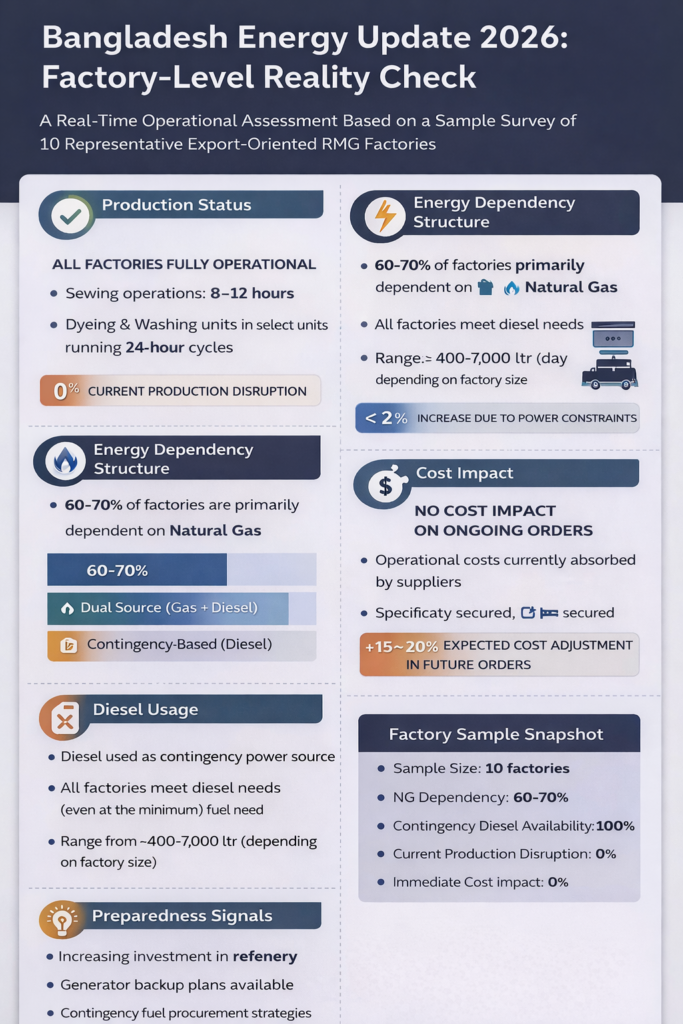
Production
• Sewing: 8–12 hours daily operations
• Dyeing/Washing: 24-hour continuous cycles
• No disruption in:
-
- Natural gas supply
- Electricity (REB)
Logistics
• Cargo movement to Chattogram port: normal
• No significant freight increase
• Minor delays due to fuel queue times
___
Factory-Level Insights (Aggregated Assessment)
Based on a representative sample of export-oriented factories:
- 0% production disruption observed
- 60–70% dependency on natural gas systems (support the generators)
- Diesel used as backup energy source
- 100% factories currently able to secure diesel supply
- No major cost impact on ongoing orders
Indicates high operational resilience and energy adaptability.
___
Buyer Risk Index (BRI) – April 2026
Overall Score: 🟡 2.1 / 5.0 (Moderate–Low Risk)
| Risk Factor | Score | Insight |
| Energy Dependency | 2.0 | Strong NG-based system |
| Backup Capacity | 1.8 | Generators widely available |
| Fuel Security | 2.2 | Diesel available but monitored |
| Cost Exposure | 2.5 | Gradual increase expected |
Scenario Outlook
- Production risk: 5–8% (only under severe disruption)
- Cost increase in production: 10–15% (mainly if power supply disrupted)
___
Cost & Market Impact
Current Situation
- No impact on ongoing orders
- Suppliers absorbing operational costs
Emerging Trends
- Yarn prices increased by ~10%-15% (cotton, polyester, viscose) with the global uncertainty impact
- Organic cotton supply tightening
Forward Outlook
- 5–15% cost increase expected in upcoming orders
- Driven by:
- Global fuel price volatility
- Raw material inflation
- Increased reliance on imported energy
Cost adjustments are expected to be gradual and aligned with global sourcing trends, rather than abrupt.
___
Global Perspective: Risk vs Reality
Global Media Highlights
- Food Crisis
- Transport disruption
- Import dependency concerns
Ground Reality in Bangladesh
- Factories operating normally
- Export logistics unaffected
- Energy supply prioritized for industry
Difference reflects perception vs actual operational status.
___
Key Takeaways for Global Brands & Buyers
1. Production Stability Maintained
Garment factories are operating at full capacity with no disruption in production or utilities.
2. Energy Supply Under Control
Fuel distribution is stabilized through government intervention and prioritized allocation.
3. Logistics Remain Functional
Export supply chain continues without delay or cost escalation.
4. Cost Pressure is Gradual
No immediate impact on ongoing orders, but future pricing may increase moderately.
5. Risk Level is Manageable
Buyer Risk Index indicates low-to-moderate sourcing risk, with strong resilience across factories.
___
Conclusion
Bangladesh’s current energy situation reflects a temporary supply adjustment within a broader global energy context, rather than a structural disruption.
With strong policy coordination and industry preparedness, the RMG sector continues to deliver stable production, reliable exports, and controlled risk exposure.
Bangladesh remains a competitive and dependable sourcing destination, with manageable short-term challenges and strong long-term fundamentals.
Looking ahead, increased reliance on imported fuel may gradually influence energy pricing, with potential downstream effects on transportation and input costs—consistent with global market dynamics.
(Apparel Times BD Desk)
**Sources:Bangladesh Petroleum Corporation (BPC); Petrobangla; Ministry of Power, Energy and Mineral Resources (Bangladesh); BGMEA industry updates; Reuters (March–April 2026); International Energy Agency (IEA); and Apparel Times BD analysis based on proprietary factory-level assessments and industry consultations.**