

The global apparel sourcing landscape is undergoing a gradual but noticeable realignment, as demand volatility, inventory corrections, and shifting sourcing strategies reshape export performance across major manufacturing hubs including China, Bangladesh, Vietnam, Cambodia, Türkiye and Sri Lanka.
China: Apparel Shipments Weaken Amid Sourcing Shifts
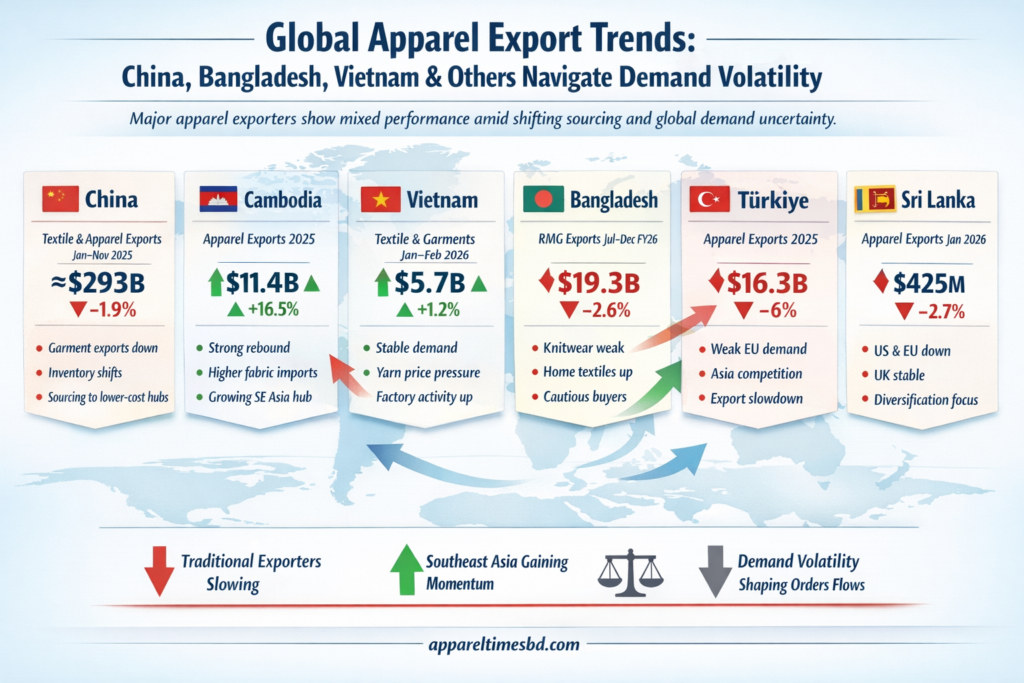
China’s textile and apparel exports declined about 1.9 per cent year-on-year to roughly $293–294 billion during January–November 2025, reflecting weaker garment shipments despite relatively resilient upstream textile exports.
While industrial textile demand remained stable, garment exports softened as global brands adjusted inventories and accelerated sourcing diversification toward lower-cost manufacturing destinations. Imports of textiles and apparel into China also declined, suggesting rising domestic self-sufficiency and softer input demand.
Cambodia: Strong Rebound Signals Sourcing Momentum
Cambodia emerged as one of the strongest performers in 2025, with apparel exports surging 16.5 per cent to about $11.4 billion.
Growth was driven by double-digit expansion in both knitted and woven garment exports, supported by improving order flows and higher factory utilisation. Rising imports of fabrics, fibres and cotton further indicate expanding production activity, reinforcing Cambodia’s role as a rapidly growing sourcing hub in Southeast Asia.
Vietnam: Modest Export Growth but Price Pressure Persists
Vietnam’s textile and garment exports reached approximately $5.7 billion in January–February 2026, rising around 1.2 per cent year-on-year.
However, declining yarn export values highlighted persistent price pressures in regional spinning markets. At the same time, higher imports of fabrics and yarn indicate steady manufacturing demand from export-oriented factories. Falling cotton imports and a sharp month-to-month export drop suggest short-term volatility despite stable medium-term production activity.
Bangladesh: Slower Growth After a Strong 2025
Bangladesh, the world’s second-largest apparel exporter, saw RMG exports decline 2.6 per cent to about $19.3 billion during July–December FY2025–26 as global demand softened.
Knitwear shipments faced greater pressure than woven apparel, while home textile exports provided a modest cushion, supported by Bangladesh’s competitive pricing and growing niche demand for value-added products.
During July–November, exports edged up roughly 0.8–1.0 per cent to around $16.3 billion, driven by stronger woven apparel and home textile shipments. However, November exports recorded a broad-based decline, reflecting continued buyer caution and lower global cotton prices affecting cotton-based products.
Türkiye: Multi-Year Export Decline Continues
Türkiye’s apparel exports continued to struggle amid weak European demand and intensifying competition from lower-cost sourcing destinations.
Total apparel exports fell around 6 per cent to roughly $16.3 billion in 2025, with knitted garments declining about 5.5 per cent and woven exports dropping around 6.5 per cent.
The trend persisted into 2026, with January apparel exports falling about 3.2 per cent year-on-year to roughly $1.31 billion. Both knitted and woven shipments contracted, extending a multi-year downtrend despite Türkiye’s strong export orientation and proximity to European markets.
Sri Lanka: Demand Volatility Weighs on Early 2026 Exports
Sri Lanka’s apparel exports declined 2.66 per cent year-on-year to $425.44 million in January 2026, reflecting uneven demand across key markets.
Exports to the United States fell 2.73 per cent to $165.11 million, while shipments to the European Union (excluding the UK) dropped 1.93 per cent to $126.99 million. Exports to the United Kingdom remained broadly stable at $61.71 million, supported by the country’s revised Developing Countries Trading Scheme (DCTS) that took effect in January 2026.
Industry body JAAF noted that global demand volatility continues to influence sourcing patterns, though new tariff developments and trade preferences may offer short-term pricing predictability and improved competitiveness.
A Shifting Global Sourcing Map
Taken together, the latest export data suggest a gradual rebalancing of global apparel production.
Lower-cost Southeast Asian hubs such as Cambodia and Vietnam are gaining momentum, while traditional exporters including China and Türkiye face structural adjustments linked to sourcing diversification and demand uncertainty.
For Bangladesh and Sri Lanka, the near-term outlook will likely depend on inventory normalisation in Western markets, cotton price movements, and brands’ evolving sourcing strategies as the global apparel industry moves into the next buying cycle.
What Bangladesh Should Do Next
As global apparel sourcing patterns evolve, Bangladesh must proactively adapt to remain competitive. Industry experts suggest that the country should focus on product diversification beyond basic knitwear, greater investment in value-added apparel, and expansion into emerging markets in Asia and the Middle East to reduce reliance on the US and EU. Strengthening backward linkage industries, particularly man-made fibre (MMF) textiles, will also be critical as global demand gradually shifts away from cotton-heavy product categories.
At the same time, improving logistics efficiency, port capacity and energy reliability could help Bangladesh maintain its price competitiveness against emerging low-cost sourcing hubs such as Cambodia and Vietnam. Strategic trade negotiations and preferential market access will also play a key role in sustaining export growth in the coming years.
Outlook
While global apparel demand remains uneven, the latest export trends suggest the industry is entering a period of structural realignment rather than a simple cyclical slowdown. As brands continue to rebalance sourcing between cost, speed and risk diversification, manufacturing hubs that can offer competitive pricing, supply chain reliability and product diversification are likely to capture the next wave of orders.
For Bangladesh, maintaining its leadership position will depend on how quickly the industry can move up the value chain, strengthen man-made fibre capabilities and improve supply chain efficiency, ensuring the country remains a central pillar of global apparel sourcing in the years ahead.
(Apparel Times BD Desk)
**Sources & Data: Export Promotion Bureau (EPB), China General Administration of Customs, Vietnam Customs statistics, Cambodia Ministry of Commerce, Turkish Exporters Assembly (TIM), Joint Apparel Association Forum (JAAF), and industry trade data compiled from national export reports and textile trade statistics.**