

How AI, Traceability and Data Are Rewriting the Rules of Global Apparel Sourcing
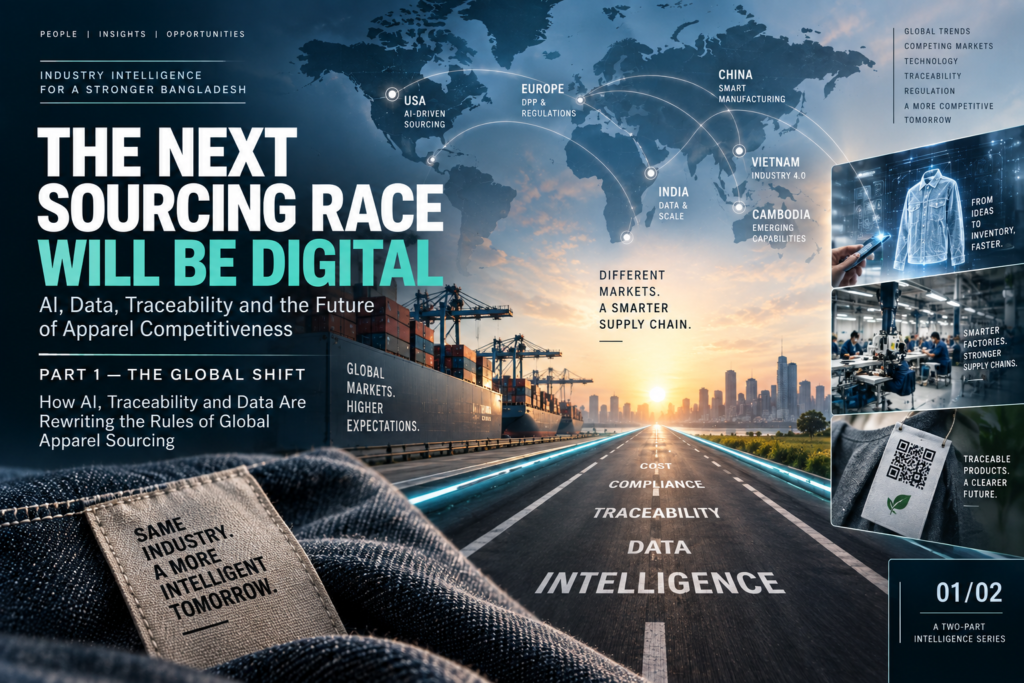
THE SOURCING RACE IS CHANGING
For decades, global apparel sourcing was built around a relatively familiar competitive formula:
Price + Quality + Lead Time + Capacity + Compliance
That formula is expanding.
Artificial intelligence is entering demand forecasting, inventory planning, product development, sourcing strategy, cost optimisation and supply-chain risk management.
Factories are connecting machinery and production systems.
Traceability platforms are creating digital records from fibre to retail.
European regulation is pushing product information toward Digital Product Passports.
And sourcing organisations are gaining the ability to analyse increasingly large amounts of supplier, product and risk data before deciding where orders should go.
The next sourcing equation could therefore increasingly resemble:
COST + SPEED + QUALITY + CAPACITY + COMPLIANCE + TRACEABILITY + CARBON + RISK + DATA + INTELLIGENCE
The immediate transformation is unlikely to look like science fiction.
Millions of garment workers will not suddenly be replaced by robots.
Something quieter is happening first.
Buyers are becoming more intelligent.
The question for manufacturing countries is whether their suppliers will become intelligent at the same speed.
1 | AI HAS ALREADY ENTERED THE BUYER’S SOURCING OFFICE
Much of the apparel industry’s public discussion around AI still focuses on generative applications:
design creation,
fashion imagery,
ChatGPT,
marketing content,
presentations
and research.
These applications matter.
But they are only the visible layer.
The 2026 US Fashion Industry Association Fashion Industry Benchmarking Study provides a much more consequential picture.
Among the surveyed fashion companies:
56% reported using AI for demand forecasting and inventory planning.
50% reported using AI for sustainability tracking and risk management.
50% reported using AI for sourcing strategy and cost optimisation.
The study surveyed executives at 30 leading US fashion companies between April and June 2026; 80% represented organisations employing more than 1,000 people.
The implication for suppliers is significant.
AI is moving closer to the point where sourcing decisions are made.
A sourcing organisation could increasingly analyse:
FOB, tariffs, MOQ, lead time, capacity utilisation, historical OTIF, quality performance, material availability, country risk, forced-labour exposure, carbon performance, logistics disruption and traceability completeness.
Not every company can do all of this today.
But the technological direction is increasingly clear.
The supplier is no longer being evaluated only by people looking at spreadsheets.
Algorithms are beginning to participate in the decision.
2 | FROM CHEAPEST FOB TO LOWEST-RISK ORDER
Consider two factories quoting the same garment.
FACTORY A
FOB: $4.75
Lead time: 90 days
OTIF: 91%
Traceability: Partial
Capacity visibility: Manual
Carbon information: Estimated
Production-risk visibility: Limited
FACTORY B
FOB: $4.82
Lead time: 75 days
OTIF: 98%
Traceability: Verified
Capacity visibility: Connected
Carbon information: Product-linked
Production-risk visibility: Predictive
The seven-cent difference suddenly becomes less straightforward.
Price pressure will remain fundamental to fashion sourcing.
But buyers increasingly have the tools to ask a broader question:
Which supplier gives us the best risk-adjusted economics of the order?
That incorporates not only FOB but also reliability, inventory exposure, markdown risk, disruption, compliance and speed.
McKinsey’s 2026 fashion outlook argues that digitising sourcing and improving end-to-end supplier collaboration could unlock double-digit product-cost savings.
At the same time, the transformation remains immature. McKinsey estimates that roughly 90% of fashion AI initiatives remain stuck at pilot stage.
That is an important reality check.
The industry has not completed an AI transformation.
It has begun one.
And that distinction gives early movers time to build an advantage.
3 | BEFORE THE ORDER: AI IS LEARNING WHAT CONSUMERS WANT
The transformation starts even before sourcing.
Fashion companies historically relied on combinations of designers, buyers, historical sales, runway intelligence and human judgement to anticipate demand.
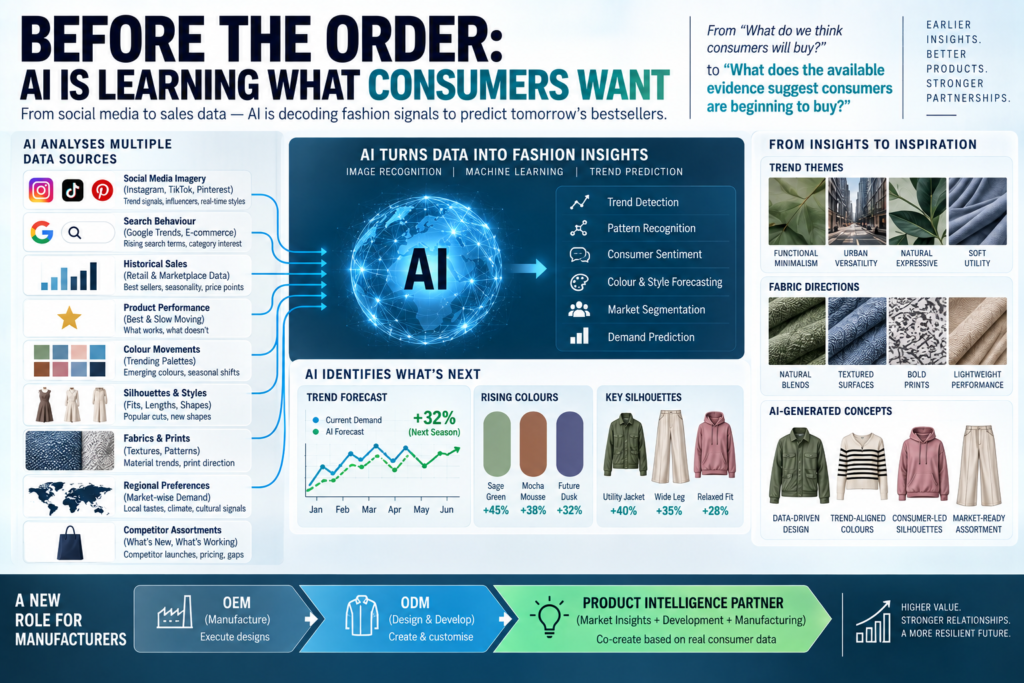
Those capabilities are increasingly being augmented by algorithms capable of analysing:
social-media imagery, search behaviour, historical sales, product performance, colour movements, silhouettes, fabrics, prints, regional preferences and competitor assortments.
Platforms such as Heuritech, for example, use image-recognition and machine-learning technology to analyse fashion signals and identify emerging product trends.
The question begins shifting from:
“What do we think consumers will buy?”
towards:
“What does the available evidence suggest consumers are beginning to buy?”
For manufacturers, that shift matters enormously.
Traditionally, many suppliers enter the product journey after receiving a buyer’s design or tech pack.
But a supplier capable of interpreting market intelligence and translating it into commercially relevant fabrics, colours, washes and silhouettes can participate much earlier.
The progression becomes:
OEM → ODM → PRODUCT INTELLIGENCE PARTNER
For sourcing destinations attempting to move beyond volume manufacturing, this could become one of the most important forms of value addition.
4 | PRODUCT DEVELOPMENT IS BECOMING DIGITAL
The traditional development process is familiar:
TREND
↓
SKETCH
↓
TECH PACK
↓
FABRIC
↓
PATTERN
↓
SAMPLE
↓
FIT
↓
CORRECTION
↓
RESAMPLE
↓
APPROVAL
Every physical iteration consumes time, materials and development capacity.
Now additional technologies are entering that process:
- AI trend intelligence
- Generative concept development
- Digital material libraries
- 3D design
- Virtual prototyping
- AI-assisted costing
- Digital fit
- PLM integration
The purpose is not simply to produce attractive digital garments.
The commercial objective is to reduce:
development time, sample iterations, material consumption, decision latency and product risk.
That has implications for manufacturers.
Factories that historically competed primarily on sewing capability may increasingly need stronger competencies in:
design, material development, 3D product creation, technical engineering, digital costing and product intelligence.
The factory is gradually moving upstream.
5 | THE MERCHANDISING DEPARTMENT COULD CHANGE EVEN FASTER
Few functions in apparel contain as much repetitive information processing as merchandising.
A merchandiser may simultaneously manage:
purchase orders, T&A calendars, lab dips, fabric approvals, testing, samples, costing, MOQ, capacity, production status, inspection, shipping documents and hundreds of emails.
Most of this information already exists digitally.
The problem is that it often exists in disconnected places.
This creates one of the strongest potential applications for the next generation of AI agents.
Imagine a merchandising system connected — with proper permissions, governance and human oversight — to:
ERP + PLM + EMAIL + T&A + TESTING + SUPPLIER PORTAL + LOGISTICS
Such a system could potentially:
identify overdue approvals, flag critical-path delays, compare actual versus planned milestones, detect inconsistent information, prepare WIP summaries, draft routine supplier follow-ups, analyse costing differences and predict shipment risk.
The merchandiser would still negotiate.
The merchandiser would still manage suppliers.
The merchandiser would still make commercial judgements.
But the balance of work could change.
Less time collecting information.
More time deciding what to do with it.
That distinction could eventually have major implications for merchandising productivity.
6 | THE FACTORY FLOOR IS BECOMING INTELLIGENT
AI is also moving from offices into physical manufacturing.
China provides an increasingly visible benchmark.
At a textile factory in Zhejiang, an AI-driven colour-processing system reportedly increased the pass rate for solid-colour printed fabrics from roughly 50% to above 90% by automatically identifying and correcting colour deviations.
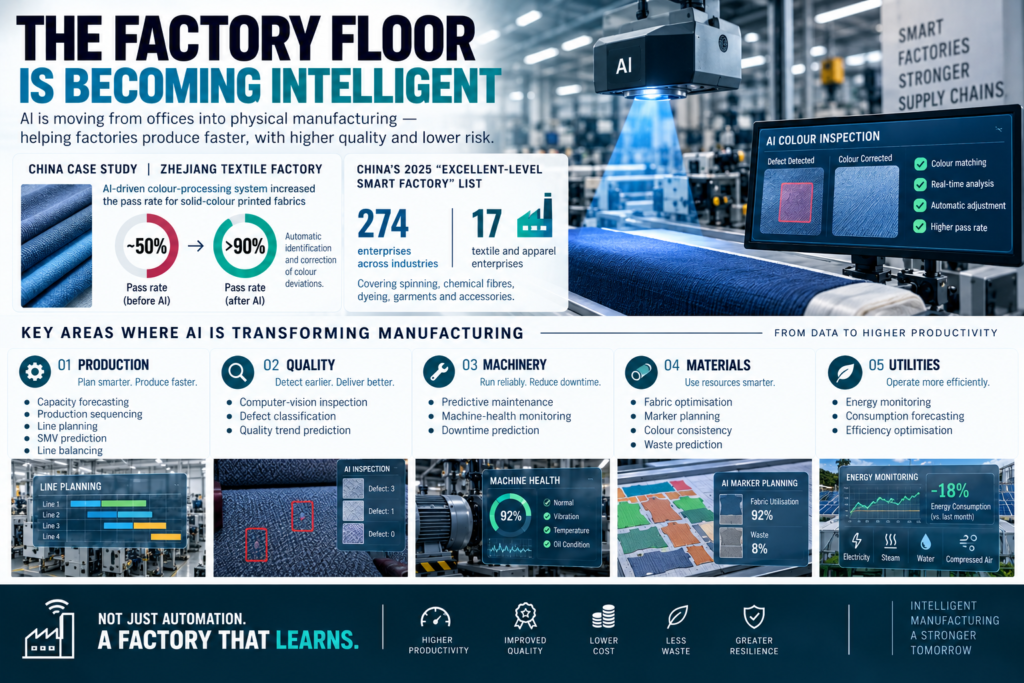
China’s Ministry of Industry and Information Technology’s 2025 “Excellent-Level Smart Factory” list contained 274 enterprises across industries.
Among them were 17 textile and apparel enterprises, spanning areas including spinning, chemical fibres, dyeing, garments and accessories.
The important point is not that Chinese garment manufacturing has suddenly become autonomous.
It has not.
The important point is that AI is moving into actual production processes.
Potential applications increasingly include:
- Production
Capacity forecasting
Production sequencing
Line planning
SMV prediction
Line balancing
- Quality
Computer-vision inspection
Defect classification
Quality trend prediction
- Machinery
Predictive maintenance
Machine-health monitoring
Downtime prediction
- Materials
Fabric optimisation
Marker planning
Colour consistency
Waste prediction
- Utilities
Energy monitoring
Consumption forecasting
Efficiency optimisation
The factory of the future may therefore contain not simply more automation, but systems capable of learning from production data.
7 | INDIA: THE SIGNAL NEXT DOOR
China may represent the technological frontier, but India deserves particular attention because it is competing aggressively for a larger share of global textile and apparel sourcing.
It would be inaccurate to claim that India has already built one unified national “AI Trust Stack” for textiles.
It has not.
What is more interesting is that several pieces of such an ecosystem are beginning to appear simultaneously.
Building the data foundation
In January 2026, India’s Ministry of Textiles signed agreements with 15 states under the Textiles focused Research, Assessment, Monitoring, Planning And Start-Up scheme — Tex-RAMPS.
The programme aims to improve the:
coverage, quality, timeliness and credibility
of textile-sector statistics while strengthening data systems at state, cluster and district levels.
At first glance this may sound administrative.
But the logic is fundamental:
DATA → INTELLIGENCE → DECISION
AI cannot compensate indefinitely for poor industrial data.
Traceability enters competitiveness policy
At India’s 2026 Textiles Summit, discussions around quality, sustainability and sourcing included Digital Product Passports and traceability.
By August, India’s Union Textiles Minister was publicly linking future textile competitiveness with:
ZERO-DEFECT MANUFACTURING + TRACEABILITY + ENVIRONMENTAL CONFORMITY
That language is revealing.
Traceability is no longer being positioned only as a sustainability requirement.
It is increasingly being connected to industrial competitiveness.
India is also developing digital infrastructure around textile mapping, product authentication, circularity and industry information.
A Centre of Excellence for Handloom Technology at IIT Delhi includes initiatives involving digital visualisation, product authentication and technology-enabled innovation.
Other initiatives include a Digital Handloom Atlas and digital infrastructure around circular textiles.
None of these projects individually transforms India’s textile industry.
Collectively, however, they show where policy thinking is heading.
8 | VIETNAM IS MEASURING DIGITAL MANUFACTURING
Vietnam deserves particular attention because its apparel sourcing profile overlaps more directly with other large Asian garment exporters.
A 2026 study covering 100 Vietnamese garment enterprises examined adoption of Industry 4.0 technologies including:
- AI
- RFID
- 3D technology
across material preparation, sample development and technical-production preparation.
This does not prove Vietnam has completed an industry-wide digital transformation.
The more important signal is that garment digital maturity is becoming something that can be measured, researched and benchmarked.
Once something becomes measurable, governments and industries can begin managing it systematically.
That is strategically important.
9 | CAMBODIA SHOULD NOT BE IGNORED
Cambodia sits at an earlier stage of digital industrialisation, but its direction is worth watching.
Research into Cambodian garment factories has found digitalisation spreading through areas including:
production systems, sustainability tracking, worker-management platforms, sensors and selected factory technologies.
Broader ASEAN research has also identified technologies such as automated cutting, hanger systems, production-planning software, barcodes and RFID across parts of Cambodia’s apparel sector.
Then, in August 2026, Cambodia’s Industry Minister Hem Vanndy made the strategic direction more explicit, arguing that AI, robotics, production-line automation and smart manufacturing would increasingly shape Cambodia’s competitiveness.
The lesson is important.
Digital transformation is no longer only a China problem.
It is no longer only an India problem.
Even lower-cost apparel sourcing destinations are beginning to think about how technology could reshape their position in the global value chain.
10 | THE INVISIBLE REVOLUTION: TRACEABILITY
Some of the most consequential digital transformation in fashion is not happening inside factories.
It is happening between them.
Consider a typical apparel supply chain:
FARM
↓
GINNER
↓
SPINNER
↓
FABRIC MILL
↓
DYEHOUSE
↓
GARMENT FACTORY
↓
LOGISTICS
↓
BRAND
↓
RETAIL
Historically, information across these tiers has often been fragmented.
That is becoming increasingly problematic.
Technology companies are attempting to build the missing digital infrastructure.
TextileGenesis by Lectra, for example, provides fibre-to-retail traceability across multiple supply-chain tiers.
Its systems are designed to help companies follow material flows and identify inconsistencies and compliance risks.
TrusTrace is building similar infrastructure around supply-chain transparency and due diligence.
In February 2026, TrusTrace and seven European retailers launched One Retail Hub, allowing brands and suppliers to provide standardised human-rights due-diligence information through a common digital infrastructure instead of responding separately to multiple retailer systems.
Participating retailers include companies such as ASOS, Zalando, ABOUT YOU, Boozt and New Look.
The broader transformation is significant:
Compliance is becoming data.
Sustainability is becoming data.
Traceability is becoming data.
And once these areas become structured data, machines can increasingly analyse them.
The sourcing conversation therefore starts moving from:
“Tell us where the material came from.”
towards:
“SHOW US THE EVIDENCE.”
11 | EUROPE IS TURNING PRODUCT DATA INTO INFRASTRUCTURE
This is where digital transformation begins moving from competitive opportunity toward regulatory necessity.
On 20 July 2026, the European Commission launched the central Digital Product Passport Registry and its testing environment under the Ecodesign for Sustainable Products Regulation.
At launch, six interoperability standards were already available covering areas including:
identifiers, data carriers, APIs, data exchange and storage.
For textile apparel, the Commission’s current indicative timetable targets adoption of the relevant ESPR Delegated Act in Q4 2027, followed by technical and implementation measures.
The Commission itself cautions that this timetable may evolve.
It would therefore be inaccurate to say that every garment entering Europe automatically requires a textile DPP from 2027.
But the direction is unmistakable.
Europe is constructing an infrastructure in which products increasingly carry structured information concerning areas such as:
identity, composition, origin, environmental characteristics, circularity and compliance.
This changes the strategic value of supply-chain information.
Historically, traceability data often sat inside compliance or sustainability departments.
Tomorrow, it could become part of the commercial identity of the product itself.
12 | THE EMERGING APPAREL COMPETITIVENESS STACK
Taken individually, these developments can look disconnected.
AI forecasting.
3D sampling.
Smart factories.
Traceability.
Digital Product Passports.
ERP.
Computer vision.
Predictive maintenance.
They are better understood as layers of the same transformation.
Apparel Times BD proposes the following analytical model:
THE INTELLIGENT APPAREL COMPETITIVENESS STACK
LAYER 7 — AI & AGENTIC DECISIONS
Sourcing recommendations • Risk prediction • Cost optimisation • Exception management
↑
LAYER 6 — INTELLIGENCE
Forecasting • Analytics • Capacity prediction • Digital twins • Decision dashboards
↑
LAYER 5 — TRUST
DPP • Traceability • Material origin • ESG information • Compliance verification
↑
LAYER 4 — CONNECTED OPERATIONS
ERP • PLM • MES • IoT • Supplier portals • Logistics integration
↑
LAYER 3 — SMART FACTORY
Computer vision • Automated planning • Predictive maintenance • Digital quality • Energy optimisation
↑
LAYER 2 — DIGITAL PRODUCT DEVELOPMENT
3D sampling • Virtual prototyping • AI design • Digital materials • Digital costing
↑
LAYER 1 — DATA FOUNDATION
Product • Material • Supplier • Machine • Cost • Capacity • Quality • Compliance • Energy
The structure reveals something frequently missed in discussions about AI.
AI sits near the top of the stack — not at the bottom.
A factory does not become intelligent because its employees use ChatGPT.
The foundation is data.
The sequence is closer to:
DIGITISE → CONNECT → STRUCTURE → ANALYSE → AUTOMATE → AI → AGENTS
Without those lower layers, sophisticated AI has very little reliable information to work with.
13 | THE NEXT SOURCING RACE
The global picture is therefore becoming clearer.
Brands are adopting AI.
Sourcing organisations are beginning to use algorithms for forecasting, risk and cost optimisation.
China is pushing smart manufacturing deeper into production.
India is connecting textile data, traceability, sustainability and digital infrastructure.
Vietnam is measuring Industry 4.0 adoption.
Cambodia is beginning to position AI and smart manufacturing as competitiveness issues.
Technology platforms are building fibre-to-retail traceability.
Europe is constructing regulatory infrastructure around digital product information.
None of these developments individually determines where the next billion dollars of apparel orders will go.
Together, however, they reveal something more important:
THE DEFINITION OF A COMPETITIVE APPAREL SUPPLIER IS CHANGING.
The traditional factory offered:
Capacity + Price + Quality + Compliance
The emerging supplier may increasingly need to offer:
Product Intelligence + Speed + Connected Manufacturing + Traceability + Verified Data + Predictive Execution
That is a considerably higher bar.
CONCLUSION | THE BUYER MAY CHANGE BEFORE THE FACTORY DOES
The fashion industry’s AI transformation remains incomplete.
Many projects will fail.
Some technology claims will prove exaggerated.
Factories will continue to depend heavily on people.
Price will remain central to sourcing.
None of that changes the direction of travel.
The most immediate disruption may not come from humanoid robots walking through sewing floors.
It may come from a sourcing manager sitting thousands of kilometres away.
That manager will increasingly have better information.
Algorithms will forecast demand.
Systems will compare suppliers.
AI will identify risk.
Traceability platforms will verify materials.
Digital passports will organise product information.
Predictive systems will identify delays.
In that environment, the factory with the cheapest sewing line may not automatically win.
The stronger supplier may increasingly be the one capable of providing:
the right product, at the right cost, at the right speed, with the right information, and the evidence to prove it.
The next sourcing race will therefore not be fought only over wages.
It will increasingly be fought over intelligence.
And that leads to the question that matters most for Bangladesh:
WHERE DO WE STAND?
Bangladesh spent the last decade building one of the world’s strongest stories around green apparel manufacturing.
But as India, China, Vietnam and even Cambodia begin preparing for a more digital sourcing environment, Bangladesh faces a different challenge.
Can the country translate its manufacturing scale into data capability?
Can factories move beyond isolated AI tools into connected systems?
Can the industry prepare for traceability and Digital Product Passports?
And can Bangladesh turn AI into a productivity advantage before digital capability becomes another sourcing criterion?
Those questions deserve their own examination.
________________________
NEXT IN THE SERIES
PART 2 — THE BANGLADESH RESPONSE
FROM GREEN FACTORY TO INTELLIGENT FACTORY
Is Bangladesh Ready for the Next Apparel Competitiveness Race?
In Part 2 we will examine:
Bangladesh’s current AI and digital maturity
The gap between leading factories and the wider industry
BGMEA’s DPP and traceability initiatives
Why LDC graduation makes productivity and digital competitiveness more urgent
The Bangladesh AI Readiness Ladder
What factories can start doing now
What BGMEA, BKMEA, BTMA, government and universities could build collectively
and ultimately:
How Bangladesh could position itself as one of the world’s most intelligent, traceable and trusted apparel manufacturing ecosystems by 2035.
(Apparel Times BD Desk)
**Sources & References : USFIA (2026 Fashion Industry Benchmarking Study) • McKinsey & Company • European Commission (ESPR/Digital Product Passport) • India Ministry of Textiles & PIB • China MIIT/Xinhua • Vietnam & ASEAN industry research • TextileGenesis/Lectra • TrusTrace • Heuritech
Research cut-off: 6 September 2026.**