

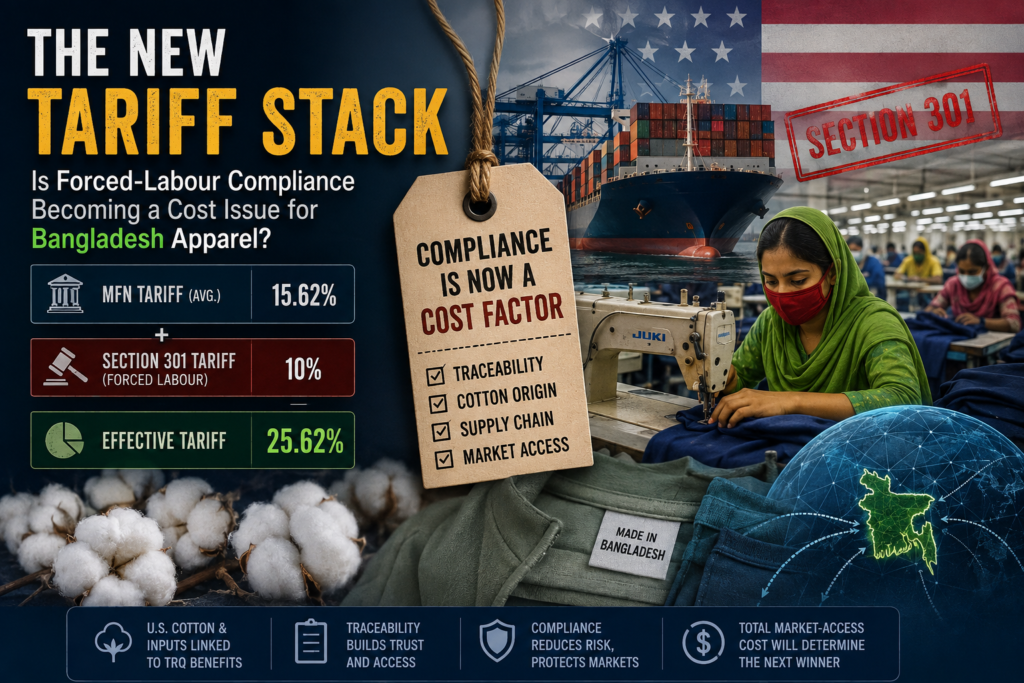
Bangladesh’s U.S. garment tariff did not suddenly jump another 10 percentage points in July. Something potentially more important happened: Washington attached that 10% burden to forced-labour enforcement—turning compliance, cotton origin and traceability into questions of sourcing economics.
For years, apparel factories have treated labour compliance primarily as a licence to operate.
Pass the audit. Maintain workplace standards. Meet the buyer’s code of conduct. Keep the factory approved.
That equation is changing.
On July 23, 2026, the United States announced Section 301 tariffs on 60 economies over what Washington described as failures to impose and effectively enforce prohibitions on imports produced with forced labour.
Bangladesh was placed in the 10% tariff tier, alongside countries including India, Cambodia, Indonesia, Malaysia, Pakistan and the United Kingdom.
The measure took effect on July 24.
But there is an important distinction behind the headline:
Bangladesh’s tariff burden did not rise from 25.62% to 35.62%.
The new 10% Section 301 tariff effectively replaced the temporary 10% U.S. tariff that expired at the same time.
For Bangladesh garments, the reported effective U.S. tariff therefore remains approximately:
15.62% existing average MFN (Most-Favored-Nation) tariff + 10% Section 301 tariff = 25.62%.
So why should Bangladesh’s apparel industry care?
Because the reason for the tariff has changed.
The previous 10% was temporary. The new 10% is explicitly connected to forced-labour import enforcement.
And Washington has simultaneously proposed a potentially important route to tariff relief: tariff-rate quotas, or TRQs, for Bangladesh and three other Asian sourcing economies based on their imports of U.S. cotton and textile inputs.
That connects areas the apparel industry once treated separately:
Compliance. Cotton origin. Traceability. Trade policy. Garment costing.
The next sourcing battle may therefore not be fought on FOB alone.
It may be fought on the total cost of market access.
1 | THE 25.62% REALITY
The first thing Bangladesh exporters need is clarity.
The current tariff structure should not be interpreted as:
MFN + 19% reciprocal tariff + 10% Section 301 tariff.
That would significantly overstate the present burden.
The reported effective U.S. tariff on Bangladesh garments is currently around 25.62%, consisting of the existing average MFN apparel duty of approximately 15.62% plus the new 10% Section 301 duty.
The Section 301 tariff became applicable on July 24, just as the temporary 10% tariff previously applied to Bangladesh expired.
For exporters, therefore, the immediate arithmetic remained broadly unchanged.
THE CURRENT STACK
| Tariff Layer | Approximate Rate |
| Existing average U.S. MFN apparel tariff | 15.62% |
| Section 301 forced-labour-related tariff | +10% |
| Reported effective rate | ~25.62% |
Individual garments can face different MFN rates depending on HS classification, fibre, construction and product category. The 15.62% figure should therefore be understood as an industry-level average, not a universal tariff applicable to every garment.
But the 25.62% benchmark gives the industry a much more accurate picture of the current competitive landscape.
SO WHAT HAPPENED TO THE 19% RECIPROCAL TARIFF?
This is where the story becomes more complicated.
The U.S.–Bangladesh Agreement on Reciprocal Trade signed in February 2026 had envisaged a 19% reciprocal tariff on most Bangladeshi goods entering the United States.
But the broader U.S. reciprocal-tariff architecture subsequently faced a major legal setback following the U.S. Supreme Court ruling against the IEEPA-based tariff mechanism.
The Bangladesh agreement has also remained politically and legally unsettled.
The practical result for apparel exporters today is important:
The 19% reciprocal tariff should not be added on top of the current 10% Section 301 tariff when calculating Bangladesh’s present effective garment tariff.
For sourcing teams, this distinction matters enormously.
A dramatic-looking theoretical tariff stack may attract attention.
An accurate landed-cost calculation wins orders.
2 | IF THE RATE DIDN’T INCREASE, WHAT ACTUALLY CHANGED?
Potentially, quite a lot.
The previous 10% tariff was a broad temporary trade measure.
The replacement 10% tariff has a very different policy foundation.
USTR’s Section 301 investigations examined whether trading partners were adequately prohibiting imports of goods produced wholly or partly with forced labour.
Bangladesh received the lower 10% Section 301 rate, rather than the 12.5% applied to many other investigated economies, because countries in the 10% category either maintain forced-labour import restrictions, have partial regimes, or have made commitments to establish and enforce such prohibitions.
That means forced-labour compliance has crossed an important boundary.
OLD MODEL
Compliance problem → Audit / corrective action / buyer pressure
EMERGING MODEL
Compliance problem → Trade action / tariff exposure / customs risk / sourcing-cost implications
This is the structural change Bangladesh should be watching.
The immediate tariff number may look familiar.
The policy logic behind it is not.
3 | THE “TARIFF STACK” IS BIGGER THAN TARIFFS
The term “tariff stack” therefore needs a broader definition.
For tomorrow’s sourcing teams, the real equation may look more like this:
TOTAL MARKET-ACCESS COST
MFN tariff
+ Trade-policy surcharge
+ Traceability cost
+ Compliance verification
+ Raw-material sourcing premium
+ Customs/disruption risk
+ Lead-time risk
= Risk-adjusted landed cost
This changes the sourcing conversation.
Historically, Bangladesh’s competitive proposition has been heavily built around FOB.
Can the factory make the garment?
At the right quality?
At the right price?
Within the required lead time?
Those questions remain fundamental.
But buyers increasingly need to answer another one:
What will this garment actually cost me by the time I can safely sell it in my market?
That is a very different calculation.
4 | COTTON HAS BECOME TRADE STRATEGY
The most interesting element of Washington’s latest action may not be the tariff itself.
It may be the proposed escape route.
The U.S. Trade Representative has been directed, when feasible, to establish tariff-rate quotas for:
Bangladesh
Cambodia
Indonesia
Malaysia
The proposed mechanism would link TRQ access to each country’s imports of U.S. inputs, specifically encouraging greater purchases of U.S. cotton and textile goods.
The stated objective is to reduce reliance on sourcing channels considered more likely to contain forced-labour inputs.
This could create an unusual commercial equation.
More qualifying U.S. textile inputs
↓
Potentially greater TRQ access
↓
Specified textile/apparel exports potentially avoid the additional Section 301 duty
↓
Lower U.S. landed cost
The detailed TRQ rules—including quota volumes, eligible products, conversion formulas, documentation and allocation mechanisms—still need to be established.
So factories should not assume:
“Use U.S. cotton = automatic 10% tariff saving.”
That is not yet the rule.
But the direction is significant.
For the first time, a sourcing manager’s decision about where cotton comes from could potentially influence the tariff treatment of the finished garment.
Raw-material procurement is becoming trade strategy.
5 | THE $1 QUESTION: WHICH GARMENT IS ACTUALLY CHEAPER?
Consider a simplified future scenario.
Two Bangladesh suppliers quote the same U.S. buyer.
SUPPLIER A
Conventional cotton/yarn sourcing
FOB: $10.00
SUPPLIER B
Qualifying U.S.-input sourcing
FOB: $10.30
On the factory cost sheet, Supplier A wins.
It is 30 cents cheaper.
But suppose the eventual TRQ structure allows Supplier B’s qualifying garment to avoid the additional 10% Section 301 tariff while Supplier A’s product remains exposed.
The buyer’s calculation changes.
A slightly higher FOB could produce a substantially lower landed cost.
The example is illustrative—the actual economics will depend on the final TRQ rules, product classification and sourcing structure.
But it demonstrates a fundamental principle:
The cheapest garment leaving Chattogram may not be the cheapest garment arriving at an American distribution centre.
That has consequences for merchandising.
Saving five cents in CM is useful.
Understanding a potential tariff difference worth many times that amount is strategic.
6 | BANGLADESH HAS A SMALL TARIFF EDGE—FOR NOW
The tariff story is not entirely negative for Bangladesh.
Current reported effective U.S. garment tariff rates show:
|
Sourcing Country |
Approx. Effective U.S. Garment Tariff |
| Bangladesh | 25.6% |
| India | 25.6% |
| Pakistan | 25.6% |
| Cambodia | 25.6% |
| Indonesia | 25.6% |
| Vietnam | 28.1% |
| China |
35.6% |
This gives Bangladesh a modest tariff advantage over Vietnam and a considerably larger one over China.
But it should not be exaggerated.
India, Pakistan, Cambodia and Indonesia reportedly sit around the same effective level as Bangladesh.
So tariff alone will not determine the winner.
The competitive question becomes more interesting:
At broadly similar tariff levels, which sourcing country can offer the best combination of:
FOB + Speed + Capacity + Product capability + Traceability + Compliance + Tariff certainty?
That is where Bangladesh still has room to differentiate.
7 | FROM FACTORY COMPLIANCE TO FIBRE TRACEABILITY
Bangladesh has invested heavily in improving garment-factory standards.
That matters.
But the next compliance challenge may increasingly sit above the sewing factory.
Consider a cotton T-shirt.
Cotton farm
↓
Ginning
↓
Spinning
↓
Knitting / weaving
↓
Dyeing & finishing
↓
Garment manufacturing
↓
Exporter
↓
Brand
↓
Customs
A garment factory might maintain excellent labour standards.
But regulators and buyers can increasingly ask:
Where was the cotton grown?
Where was the yarn spun?
Who supplied the fabric?
Were intermediaries involved?
Can every transaction be documented?
Can the documentation withstand regulatory scrutiny?
That is why the industry’s next compliance transformation cannot stop at Tier 1.
“Made in Bangladesh” may no longer provide enough information.
Increasingly, buyers need to know the origin of everything inside what was made in Bangladesh.
8 | TRACEABILITY HAS A COST
Tariffs are easy to see.
The less visible costs can be just as important.
A credible upstream traceability programme may require:
- supplier mapping beyond Tier 1;
- chain-of-custody documentation;
- digital traceability systems;
- raw-material segregation;
- verification and testing;
- additional compliance manpower;
- alternative material sourcing;
- stronger transaction records;
- additional working capital;
- longer development or approval processes.
None of these necessarily appears as a line called “tariff.”
But all of them affect commercial competitiveness.
That creates a new category for garment executives to understand:
MARKET-ACCESS COST
Factories traditionally concentrate on the:
Cost of making the garment.
Increasingly, they must also understand the:
Cost of proving the garment can enter the market.
The distinction will become increasingly important.
9 | EUROPE IS MOVING IN THE SAME DIRECTION
The United States is not alone.
The European Union’s Forced Labour Regulation entered into force in December 2024 and becomes applicable from 14 December 2027.
It prohibits products made with forced labour from being placed on or made available in the EU market, as well as from being exported from the EU.
The American and European systems are different.
One should not be presented as simply another version of the other.
But strategically they point in the same direction:
Compliance is moving closer to the border.
Historically, poor compliance could cost a supplier its buyer approval.
Increasingly, forced-labour exposure can affect the product’s ability to access a market at all—or the economics under which it does so.
For Bangladesh, whose apparel industry is heavily dependent on the EU and U.S. markets, that shift deserves board-level attention.
10 | ANOTHER MARKET-ACCESS CLOCK IS TICKING
There is another reason the timing matters.
Bangladesh remains scheduled to graduate from the United Nations’ Least Developed Country category on 24 November 2026.
However, the situation is not settled.
Bangladesh has requested a three-year extension of the preparatory period to November 2029. The UN Committee for Development Policy concluded that an extension would be appropriate subject to progress on domestic reforms, and ECOSOC adopted a decision in July recommending that the General Assembly act on the matter before the current November 24 graduation date.
Until the General Assembly decides, the existing 2026 graduation schedule remains formally in place.
This is a separate policy issue from the U.S. forced-labour tariff.
But commercially the two belong to the same bigger conversation.
Bangladesh’s traditional preferential-access environment is changing at the same time that new compliance-linked market-access rules are emerging.
Whether graduation occurs in 2026 or is deferred, the long-term message for the apparel sector is the same:
Bangladesh cannot build its next decade of competitiveness around tariff preference alone.
11 | BANGLADESH HAS SOMETHING IMPORTANT TO DEFEND
Bangladesh exported approximately $38.7 billion of apparel in FY2025-26, accounting for roughly 80.6% of the country’s merchandise exports.
Few major economies depend so heavily on one export industry.
That concentration magnifies changes that might otherwise appear technical.
A few percentage points of tariff difference can influence sourcing decisions.
A customs hold can destroy a delivery window.
A traceability failure can create reputational and financial consequences far beyond the original order.
But Bangladesh also enters this transition with significant strengths.
It has:
- Scale.
- A mature manufacturing ecosystem.
- Large knitting and processing capabilities.
- Deep buyer relationships.
- Increasing sustainability credentials.
- Decades of experience adapting to new compliance requirements.
The opportunity is to turn those capabilities into the next competitive proposition.
12 | FROM GREEN FACTORY TO TRACEABLE FACTORY
Bangladesh has built a powerful global story around green manufacturing.
The next chapter could be:
TRACEABLE MANUFACTURING
Imagine a supplier telling a buyer:
- Here is the cotton origin.
- Here is the spinner.
- Here is the fabric mill.
- Here is the transaction history.
- Here is our forced-labour risk assessment.
- Here is the applicable tariff scenario.
- And here is your final landed cost.
That factory is selling something more valuable than sewing capacity.
It is selling:
Market-access certainty.
And uncertainty is expensive.
Certainty therefore has commercial value.
13 | FIVE THINGS FACTORIES SHOULD DO NOW
1. MAP BEYOND TIER 1
Factories should identify critical yarn, fabric, fibre, trim and subcontracting relationships.
The question is no longer simply:
Who supplies us?
It is increasingly:
Who supplies our suppliers?
2. BUILD MATERIAL-ORIGIN INTELLIGENCE
Factories should understand the origin of cotton, yarn, fabric and other strategically important inputs used across major programmes.
Unknown origin is increasingly becoming a commercial risk.
3. MODEL U.S.-INPUT SCENARIOS
Factories with significant U.S. business should begin modelling:
Conventional sourcing cost
versus
U.S.-cotton/textile sourcing cost
versus
potential TRQ tariff benefit.
The final rules are not yet available—but companies can prepare the analytical capability now.
4. CONNECT COMMERCIAL AND COMPLIANCE
This cannot remain the sustainability department’s problem.
Future decisions increasingly require:
Merchandising + Sourcing + Compliance + Commercial + Finance + Supply Chain
working from the same data.
5. BUILD BUYER-READY EVIDENCE
For strategic programmes, suppliers should aim to retrieve critical upstream documentation rapidly rather than beginning the search after a buyer or regulator raises a question.
Speed of evidence could become part of speed-to-market.
14 | WHAT BANGLADESH SHOULD DO AT INDUSTRY LEVEL
Individual factories cannot solve every upstream traceability problem independently.
Three national priorities deserve attention.
BUILD INTEROPERABLE TRACEABILITY
Industry bodies and government should explore common standards for documenting strategically important textile inputs without forcing thousands of exporters to develop incompatible systems.
STRENGTHEN FORCED-LABOUR IMPORT ENFORCEMENT
The distinction between legislation and credible implementation will matter.
Bangladesh’s placement in the 10% Section 301 tier already demonstrates that trade policy is responding to countries’ forced-labour import regimes and commitments.
TREAT THE U.S. TRQ AS INDUSTRIAL POLICY
The eventual Bangladesh TRQ should be analysed far beyond customs administration.
Its design could influence:
- U.S. cotton imports;
- domestic spinning;
- fabric sourcing;
- product eligibility;
- exporter allocation;
- documentation;
- quota utilisation;
- U.S. buyer sourcing strategies.
If structured intelligently, it could potentially become a competitive instrument.
If structured poorly, it could become another layer of bureaucracy.
15 | THE NEXT COMPETITIVE BATTLE
Bangladesh built its apparel industry around a powerful equation:
Competitive price + scale + manufacturing capability.
Then buyers added:
Quality + delivery + compliance.
Then came:
Sustainability + speed + flexibility.
The next equation may be:
PRICE + QUALITY + SPEED + SUSTAINABILITY + TRACEABILITY + TARIFF + RISK
This changes what “competitive” means.
Consider two Suppliers.
| Supplier A | Supplier B |
| Lower FOB | Slightly higher FOB |
| Weak upstream visibility | Traceable materials |
| Higher origin uncertainty | Verified supply chain |
| Limited tariff modelling | Landed-cost modelling |
| Reactive documentation | Buyer-ready evidence |
Twenty years ago, Supplier A probably won.
Tomorrow, Supplier B increasingly might.
Not because compliance suddenly became more important than price.
But because compliance can now change the economics of price itself.
THREAT OR OPPORTUNITY?
Bangladesh faces three possible paths.
SCENARIO 1 — BUSINESS AS USUAL
Factories continue focusing primarily on FOB and Tier-1 compliance.
Risk: upstream traceability and tariff complexity gradually erode competitiveness.
SCENARIO 2 — COMPLIANCE UPGRADE
Factories build stronger supply-chain mapping, origin verification and documentation.
Result: Bangladesh becomes better prepared for U.S. and EU enforcement.
SCENARIO 3 — TRADE-ENGINEERED SOURCING
Factories combine traceability with strategic material sourcing, tariff modelling and—where commercially viable—the future U.S.-input-linked TRQ.
Potential result: compliance moves from cost centre to competitive advantage.
The third scenario deserves far more attention from Bangladesh’s apparel leadership.
The headline number can be misleading.
Bangladesh’s effective U.S. garment tariff did not suddenly jump another ten percentage points in July.
It remains around 25.6%, slightly below Vietnam’s reported 28.1% and substantially below China’s 35.6%.
But focusing only on that number misses the bigger story.
Washington has now explicitly connected tariff policy with forced-labour import enforcement.
It is simultaneously exploring tariff relief tied to U.S. cotton and textile inputs.
Europe is preparing its own forced-labour market prohibition.
And buyers are moving deeper into supply-chain traceability.
Together, these developments suggest that the economics of apparel sourcing are changing.
For Bangladesh, the next competitive advantage may therefore come not from quoting another five cents lower.
It may come from being able to tell the buyer:
- where the product came from,
- what risk it carries,
- what tariff it attracts,
- and what it really costs when it reaches the market.
Because the next sourcing battle will not be fought on FOB alone.
It will be fought on total market-access cost—and Bangladesh may have more room to compete than the tariff headlines suggest.
(Apparel Times BD Desk)
**Sources & References:USTR; U.S. Federal Register; The White House; European Commission & EUR-Lex; United Nations/ECOSOC; BGMEA; The Daily Star; Fibre2Fashion.
Data and regulatory information updated as of 1 September 2026. Tariff rates may vary by HS code and product category; proposed U.S. textile/apparel TRQ details remain subject to implementation.**