

Is Bangladesh Ready for the Next Apparel Competitiveness Race?
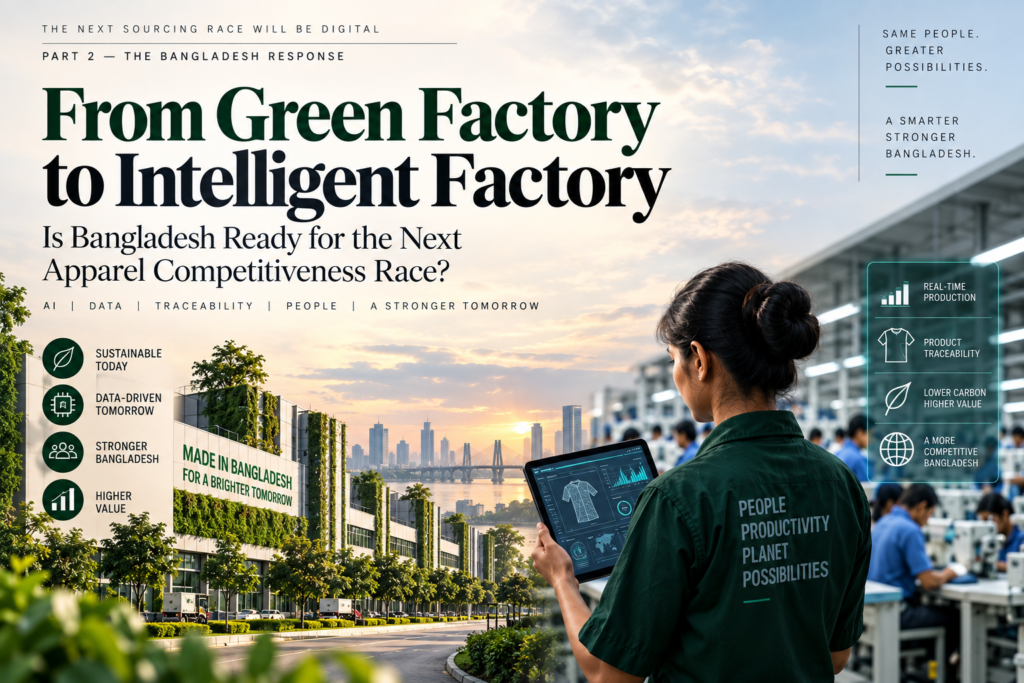
BANGLADESH WON THE LAST COMPETITIVENESS RACE
There is a danger in discussing Bangladesh’s technological future by beginning with what the country lacks.
A better place to start is with what it has already built.
Bangladesh transformed itself from a relatively small garment producer into one of the world’s most important apparel sourcing destinations. In FY2025–26, the country exported approximately $38.7 billion of ready-made garments, accounting for more than 80 per cent of national merchandise exports.
Its transformation has not been limited to volume.
The industry has spent more than a decade investing in factory safety, environmental performance, energy efficiency, compliance systems and modern manufacturing infrastructure.
According to BGMEA’s live sustainability dashboard, Bangladesh had 291 LEED-certified green garment factories as of 9 September 2026, maintaining the country’s position as the world’s largest concentration of LEED-certified green garment factories.
That achievement matters.
It demonstrated something important about Bangladesh’s apparel industry:
When the rules of global sourcing change, Bangladesh can change with them.
But the next transformation may be different.
The previous competitiveness cycle was heavily influenced by cost, capacity, safety, compliance and sustainability.
The emerging one is adding new variables:
COST + SPEED + QUALITY + CAPACITY + COMPLIANCE + TRACEABILITY + CARBON + RISK + DATA + INTELLIGENCE
The green factory will remain important.
It may simply no longer be enough.
THE NEXT FACTORY MAY NEED TO THINK
Part 1 of this series showed how AI is entering demand forecasting, sourcing strategy, product development, production planning, quality control, maintenance and supply-chain risk management.
At the same time, traceability is turning previously fragmented information into structured data.
The implications for manufacturers are significant.
A competitive factory of the future may not merely need to manufacture an order efficiently.
It may increasingly need to know:
- where its materials came from,
- whether production is moving according to plan,
- where quality risk is developing,
- whether capacity assumptions remain realistic,
- how much energy a product consumed,
- where a shipment is likely to be delayed,
- whether a material claim can be verified,
- and what management should do next.
That requires something beyond automation.
It requires connected information.
And eventually, intelligence built on top of it.
SO WHERE DOES BANGLADESH ACTUALLY STAND?
There is currently no sufficiently robust nationwide dataset showing what percentage of Bangladesh’s garment factories are using artificial intelligence in production.
That is important to acknowledge.
It would therefore be misleading to claim that “Bangladesh RMG has adopted X per cent AI” or to assign the entire industry a single technological maturity level.
The reality is much more uneven.
Some leading manufacturers operate sophisticated ERP systems, automated cutting, digital production monitoring, advanced machinery, energy-management systems, 3D product development and increasingly data-driven management.
Elsewhere, important workflows still depend heavily on spreadsheets, emails, WhatsApp messages, manually prepared reports and individual follow-up.
This means Bangladesh’s digital challenge should not be reduced to:
“Are factories using AI?”
The better question is:
How far has each factory progressed towards becoming an intelligent enterprise?
BANGLADESH AI READINESS LADDER
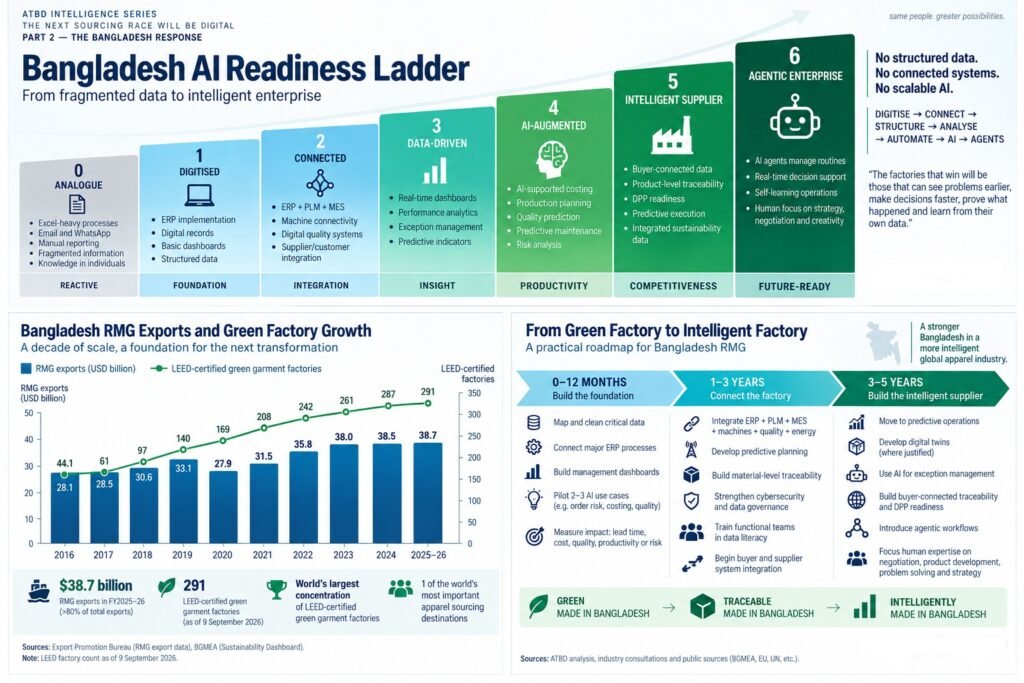
Apparel Times BD proposes a simple analytical framework for thinking about that journey.
STAGE 0 — ANALOGUE
Excel-heavy processes
Email and WhatsApp follow-up
Manual reporting
Fragmented information
Knowledge dependent on individuals
↓
STAGE 1 — DIGITISED
ERP implementation
Digital records
Basic dashboards
Structured transactional data
↓
STAGE 2 — CONNECTED
ERP + PLM + MES
Machine connectivity
Digital quality systems
Supplier/customer system integration
↓
STAGE 3 — DATA-DRIVEN
Real-time dashboards
Performance analytics
Exception management
Predictive indicators
↓
STAGE 4 — AI-AUGMENTED
AI-supported costing
Production planning
Quality prediction
Predictive maintenance
Risk analysis
↓
STAGE 5 — INTELLIGENT SUPPLIER
Buyer-connected information
Product-level traceability
DPP readiness
Predictive execution
Integrated sustainability data
↓
STAGE 6 — AGENTIC ENTERPRISE
AI agents monitor routine workflows, identify exceptions, coordinate information and recommend actions while people concentrate on negotiation, creativity, strategy and judgement.
The most important lesson from this ladder is not Stage 6.
It is the sequence.
DIGITISE → CONNECT → STRUCTURE → ANALYSE → AUTOMATE → AI → AGENTS
A factory cannot realistically jump from fragmented spreadsheets directly into enterprise-scale artificial intelligence.
No structured data. No connected systems. No scalable AI.
BANGLADESH IS NOT STARTING FROM ZERO
Bangladesh’s technology discussion should avoid two extremes.
The first is believing that buying an AI tool automatically creates an intelligent factory.
The second is assuming Bangladesh has done nothing.
Neither is accurate.
Bangladesh already possesses something enormously valuable: a large manufacturing ecosystem, sophisticated exporters, experienced engineering and merchandising teams, increasingly modern machinery, sustainability infrastructure and deep relationships with global buyers.
There are also signs that the industry’s institutional conversation is moving towards innovation.
On 12 May 2026, BGMEA launched its “Future Forward” dialogue around fabric, design and innovation, bringing manufacturers, mills, designers and sustainability providers together around a more collaborative innovation ecosystem.
The opportunity now is to connect these capabilities.
Because automation inside individual departments is not the same as an intelligent enterprise.
A cutting machine may be digital.
A production dashboard may be digital.
An ERP may be digital.
A sustainability database may be digital.
But if those systems cannot exchange information, the organisation may still make decisions through fragmented data.
That is the next frontier.
TRACEABILITY MAY BECOME BANGLADESH’S DIGITAL GATEWAY
Interestingly, Bangladesh’s transition towards intelligent manufacturing may not begin with AI.
It may begin with traceability.
In May 2025, BGMEA, DigiProd Pass and Digital Architect signed an MoU for a 24-month pilot project aimed at developing blockchain-enabled Digital Product Passport capabilities within Bangladesh’s garment sector.
Selected manufacturers are expected to participate in areas including data collection, lifecycle assessment, system deployment, training and integration.
The direction accelerated in 2026.
On 10 May 2026, BGMEA signed an MoU with AWARE in Dhaka to advance blockchain-based supply-chain transparency and Digital Product Passport readiness. The initiative is designed to connect raw-material information with garment production data while incorporating data-sovereignty principles.
A day later, on 11 May 2026, BGMEA signed an MoU with Open Supply Hub, including the use of standardised factory identification through the Universal OS ID and an ambition to reduce repetitive reporting across different compliance and supply-chain systems.
Bangladesh’s Ministry of Commerce has also been examining a broader national product-traceability strategy, with BGMEA participating in related consultations.
These initiatives are still emerging.
But together they point towards something bigger.
- Compliance is becoming structured data.
- Sustainability is becoming structured data.
- Material origin is becoming structured data.
- Factory identity is becoming structured data.
And once information becomes structured, interoperable and machine-readable, AI becomes considerably more useful.
That is why traceability should not be viewed only as another compliance requirement.
It could become part of Bangladesh’s digital industrial infrastructure.
EUROPE MAKES THIS MORE URGENT
The European Union’s Digital Product Passport will eventually require far more structured product information across supply chains.
But the timeline needs to be understood carefully.
Contrary to some industry claims that every garment entering Europe will automatically require a DPP from 2027, the European Commission currently states:
Q4 2027: Planned adoption of the ESPR Delegated Act for textiles.
Detailed guidance, technical specifications and implementation measures are expected to follow, and the implementation timetable may evolve.
So the immediate challenge is not attaching QR codes to garments tomorrow.
It is building the capability behind them.
A QR code is merely the doorway.
The real infrastructure is the information behind it:
FIBRE → YARN → FABRIC → PROCESSING → GARMENT → LOGISTICS → BRAND
If Bangladesh can reliably connect those layers, DPP readiness could evolve from a compliance cost into a competitive capability.
THE LDC CLOCK MAKES THE DIGITAL CLOCK MORE IMPORTANT
Bangladesh is simultaneously navigating another major transition.
As of the research cut-off for this report, Bangladesh remains scheduled to graduate from the United Nations’ Least Developed Country category on 24 November 2026.
Bangladesh has requested a three-year extension. The UN Committee for Development Policy supported an extension subject to meaningful reform progress, while ECOSOC recommended that the UN General Assembly act on the matter before the scheduled graduation date.
The final timetable therefore remains time-sensitive.
Even if graduation proceeds on the existing schedule, Bangladesh would continue benefiting from the European Union’s Everything But Arms (EBA) preferences for a further three-year transition period—roughly through late 2029—and could subsequently seek GSP+, subject to eligibility and conditions.
The exact graduation timetable matters.
But the strategic direction matters more.
Bangladesh is approaching a period in which traditional trade advantages may evolve at the same time that buyers are demanding more digital evidence, transparency, sustainability and speed.
That creates two overlapping transitions:
TRADE-PREFERENCE TRANSITION
and
DIGITAL-COMPETITIVENESS TRANSITION
This is why AI and digitalisation should not be treated simply as technology projects.
They are becoming part of the economics of post-LDC competitiveness.
A possible future equation is:
PRODUCTIVITY + SPEED + VALUE ADDITION + TRACEABILITY + DATA + INNOVATION
WHERE COULD AI ACTUALLY CREATE VALUE?
The Bangladesh discussion often starts with generative AI: writing emails, preparing presentations, conducting research or producing design concepts.
Useful—but relatively small compared with the potential industrial opportunity.
Consider the wider apparel value chain.
| FUNCTION | POTENTIAL INTELLIGENT APPLICATION |
| Product Development | Trend intelligence, concept development, material recommendations |
| Costing | Consumption prediction, benchmarking, scenario analysis |
| Merchandising | T&A monitoring, exception alerts, communication automation |
| Planning | Capacity forecasting, production sequencing |
| Industrial Engineering | SMV prediction, line balancing, productivity analysis |
| Quality | Computer vision, defect classification, quality prediction |
| Machinery | Predictive maintenance, machine-health monitoring |
| Materials | Fabric utilisation, marker optimisation, waste prediction |
| Energy | Consumption forecasting and efficiency optimisation |
| Sourcing | Supplier comparison, material-price intelligence, risk analysis |
| Compliance | Document analysis, traceability and risk flags |
| Management | Predictive dashboards and decision support |
The objective is not replacing every person performing these functions.
It is improving the quality and speed of decisions.
MERCHANDISING COULD BE THE FASTEST OPPORTUNITY
One of Bangladesh’s strongest early AI opportunities may not be robotics.
It may be merchandising.
Consider how much time a merchandising organisation spends collecting information.
A typical team may continuously track:
sample approvals, lab dips, fabric bookings, testing, trims, production status, inspection, shipment bookings, costing revisions, buyer comments and dozens of T&A milestones.
The information may already exist.
The problem is that people spend enormous amounts of time finding it, checking it, consolidating it and chasing it.
Now imagine an AI agent connected—with appropriate permissions, security and human controls—to:
ERP + PLM + EMAIL + T&A + TESTING + PRODUCTION + LOGISTICS
Instead of a merchandiser asking:
“Where is the lab dip approval?”
the system could potentially say:
“Lab dip approval is two days overdue. Bulk dyeing is scheduled for Friday. Based on the current sequence, failure to receive approval tomorrow creates a potential four-day shipment risk.”
That is a very different form of automation.
The AI is not merely generating text.
It is interpreting operational information.
At scale, similar systems could monitor thousands of milestones and direct human attention towards the orders that actually require intervention.
The merchandiser does not disappear.
The merchandiser becomes more valuable.
Less chasing.
More decision-making.
THE BIGGEST BARRIER MAY NOT BE AI
This leads to perhaps the most important lesson for Bangladesh.
The main constraint may not be access to artificial intelligence.
AI technology is becoming increasingly accessible.
The difficult work sits underneath it.
DATA QUALITY – Is the information reliable?
SYSTEM INTEGRATION – Can ERP, PLM, production, quality and logistics systems communicate?
PROCESS DISCIPLINE – Are workflows standardised enough to automate?
SKILLS – Can merchandising, IE, production and management teams interpret data?
CYBERSECURITY – Can commercially sensitive buyer and factory information be protected?
INTEROPERABILITY – Can factory systems communicate with buyer and traceability platforms?
INVESTMENT – Can the business case be demonstrated before technology spending scales?
LEADERSHIP – Does management treat digitalisation as an IT project—or a business transformation?
Installing software is relatively easy.
Changing how an organisation makes decisions is harder.
WHAT SHOULD A FACTORY DO TOMORROW?
The answer is probably not: “Buy AI.”
A better starting point is to identify the factory’s current maturity and move one stage forward.
0–12 MONTHS — BUILD THE FOUNDATION
Map critical data.
Identify where Excel and manual duplication remain.
Clean master data.
Connect major ERP processes.
Build management dashboards.
Identify two or three AI use cases with measurable commercial outcomes.
Potential pilots could include:
- order-risk prediction,
- costing intelligence,
- quality analytics,
- predictive maintenance,
- merchandising exception management.
The metric should not be:
“Did we implement AI?”
It should be:
“Did lead time, cost, quality, productivity or risk improve?”
1–3 YEARS — CONNECT THE FACTORY
Integrate:
ERP + PLM + MES + MACHINES + QUALITY + ENERGY + MATERIALS
Develop predictive production planning.
Build material-level traceability.
Strengthen cybersecurity and data governance.
Train functional teams—not only IT departments—in data literacy.
Begin connecting internal information with customer and supplier systems.
3–5 YEARS — BUILD THE INTELLIGENT SUPPLIER
Move from descriptive dashboards towards predictive operations.
Develop digital twins where commercially justified.
Use AI for production and supply-chain exception management.
Build buyer-connected traceability.
Introduce agentic workflows for repetitive coordination.
Use human expertise for the work where it creates the greatest value:
NEGOTIATION
PRODUCT DEVELOPMENT
PROBLEM SOLVING
RELATIONSHIP MANAGEMENT
STRATEGY
BANGLADESH CANNOT DO THIS FACTORY BY FACTORY
Individual factories will innovate at different speeds.
That is natural.
But some parts of the transformation require collective infrastructure.
BGMEA, BKMEA and BTMA can help establish common terminology, digital capability benchmarks, DPP-readiness programmes, shared learning platforms and interoperability discussions.
Government can support digital infrastructure, investment incentives, cybersecurity standards, technology adoption and national traceability architecture.
Universities can bring textile engineering, industrial engineering, computer science and data science closer together.
The industry increasingly needs professionals who understand both:
GARMENTS + DATA
not one or the other.
Technology companies can develop affordable solutions around Bangladesh’s actual operating problems rather than simply importing expensive systems designed for different manufacturing environments.
Brands and retailers also have a role.
If every buyer develops another independent portal demanding another version of the same supplier information, digitalisation could simply create a more sophisticated form of duplication.
Interoperability matters.
DOES BANGLADESH NEED A DIGITAL APPAREL INFRASTRUCTURE?
This may ultimately be the bigger policy question.
Not one giant database.
Not one government-controlled platform.
And certainly not another portal where factories manually enter the same information.
Instead, Bangladesh could explore a shared, interoperable digital infrastructure allowing authorised information to move securely between existing systems.
Imagine an ecosystem where common standards can connect:
FACTORY IDENTITY
↓
MATERIAL ORIGIN
↓
PRODUCT DATA
↓
PRODUCTION INFORMATION
↓
ENVIRONMENTAL DATA
↓
TRACEABILITY
↓
LOGISTICS
↓
BUYER SYSTEMS
Factories retain their own operational systems.
Brands retain theirs.
Technology providers continue competing.
But common identifiers, standards and APIs allow verified information to move between them.
The Open Supply Hub partnership and emerging DPP initiatives suggest that pieces of this architecture are already beginning to appear.
The opportunity is to think beyond individual pilots.
Because if Bangladesh can create an interoperable digital layer across one of the world’s largest apparel manufacturing ecosystems, the value could extend far beyond regulatory compliance.
It could become infrastructure for the next generation of sourcing.
FROM GREEN FACTORY TO INTELLIGENT FACTORY
Bangladesh’s sustainability transformation offers a useful precedent.
Green factories were once considered expensive exceptions.
Then sustainability became a sourcing issue.
Factories invested.
Capabilities grew.
Engineers learned.
Technology suppliers emerged.
Industry institutions promoted the transformation.
And Bangladesh eventually turned green manufacturing into part of its global identity.
Digital intelligence could follow a similar trajectory.
But there is one major difference.
Green transformation largely changed how factories consumed resources and managed environmental performance.
Intelligent transformation could change how factories make decisions.
That reaches almost every department:
Design, Merchandising, Sourcing, Planning, IE, Production, Quality, Maintenance, Compliance, Commercial, Logistics, Management.
That is why this transformation may ultimately be deeper.
THE NEXT BANGLADESH STORY
For decades, Bangladesh’s global proposition was straightforward: MADE IN BANGLADESH
Then the industry built another identity: GREEN MADE IN BANGLADESH
The next evolution could be: TRACEABLE MADE IN BANGLADESH
And eventually: INTELLIGENTLY MADE IN BANGLADESH
This does not mean covering factories with robots.
It means creating manufacturing organisations capable of learning from their own information.
A factory that identifies risks before they become delays.
A merchandiser who sees exceptions before chasing them.
A production manager who predicts bottlenecks instead of discovering them at the end of the shift.
A maintenance team that intervenes before a critical machine fails.
A sourcing team that compares materials using cost, performance, sustainability and risk simultaneously.
A buyer who can verify the journey of a product rather than simply requesting another certificate.
That is the intelligent factory.
TAKEAWAY
Bangladesh does not need to win an AI race against China.
Nor does it need to copy India’s digital initiatives or purchase every technology appearing in the market.
It needs to solve a more practical problem:
How can Bangladesh use data and technology to become a faster, more predictable, more transparent and higher-value sourcing destination?
The answer begins before AI.
It begins with structured information.
Connected systems.
Digital skills.
Traceability.
Process discipline.
And measurable business problems.
Artificial intelligence then becomes the layer that helps organisations interpret that information faster and act on it earlier.
Bangladesh has already demonstrated that an apparel manufacturing nation can reinvent itself around safety, compliance and sustainability.
The next transformation may be around intelligence.
And the factories that win will not necessarily be those with the most AI tools.
They will be those that can:
SEE PROBLEMS EARLIER.
MAKE DECISIONS FASTER.
PROVE WHAT HAPPENED.
LEARN FROM THEIR OWN DATA.
Bangladesh built the green factory.
The next challenge is to build the intelligent one.
(Apparel Times BD Desk)
**SOURCES & METHODOLOGY : Research draws on BGMEA, EPB, United Nations/CDP/ECOSOC, European Commission, DigiProd Pass, AWARE, Open Supply Hub and relevant apparel digitalisation and technology research.
Research cut-off: 9 September 2026.**